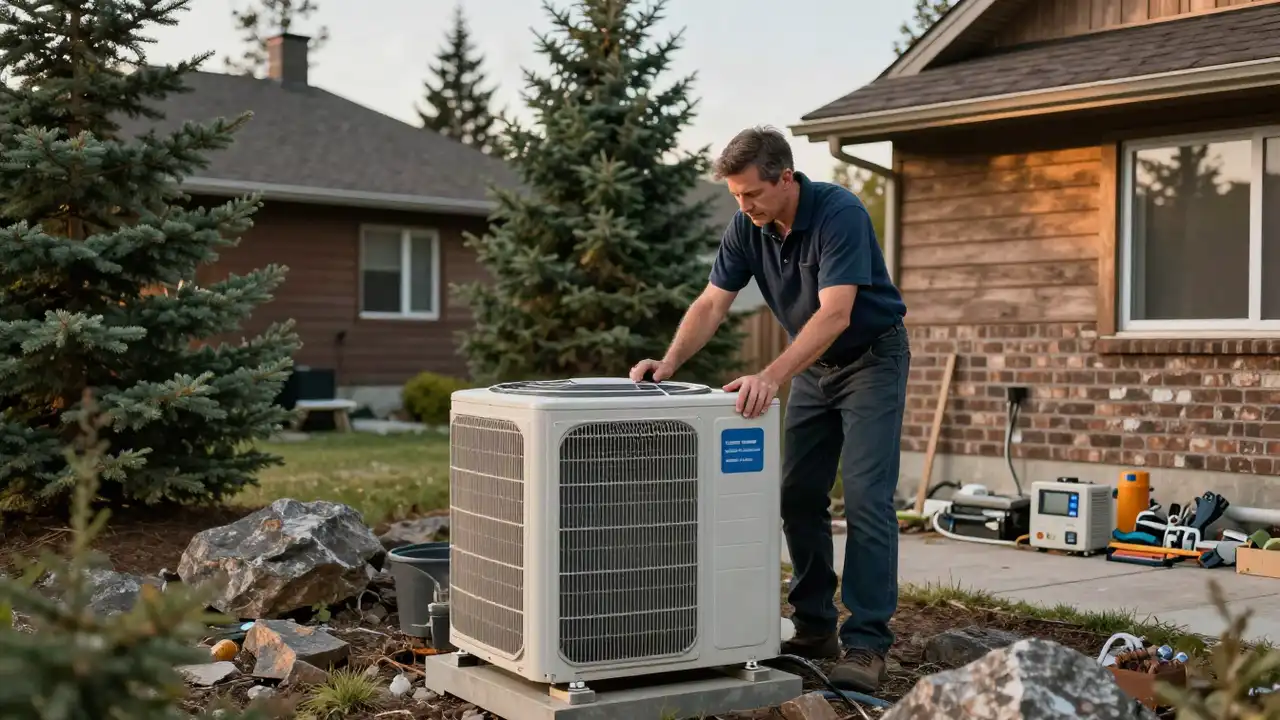
You can cool a home addition without overworking your AC by matching the cooling load to the new square footage - either by upsizing the existing system and extending the ducts, or by adding a dedicated unit like a mini-split for the new space. The wrong move is to simply open a vent from the old trunk line and hope for the best; that's how compressors burn out and the original rooms stop cooling. We install and design cooling for additions across Sudbury, Ontario, and this post walks through the sizing math, ducting options, and 2026 costs so you can pick the right path before the first hot week hits.
Why your existing AC struggles with a new addition
Your existing AC was sized for the house you had before the addition, not the one you have now. A 400-square-foot sunroom or garage conversion adds real cooling load - often 6,000 to 12,000 BTU per hour - and the original condenser has no spare capacity to cover it.
When you tap into the existing ductwork to feed the new room, three things go wrong at once. First, the return air path is usually undersized, so the new room pressurizes and the door whistles. Second, the extra duct run drops static pressure, which means less air reaches the far bedrooms. Third, the compressor runs longer cycles trying to hit a setpoint it can't reach, which shortens its life and spikes your hydro bill.
We see this constantly in older Sudbury homes where the original system was a 2-ton unit for 1,400 square feet, and the homeowner added a 350-square-foot family room off the back. The fix isn't always a bigger condenser - sometimes it's better duct design and a zoned setup. But you have to run the load calculation first.
Will my central AC handle a home addition in Sudbury, Ontario?
Probably not at full capacity, and definitely not without a load calculation. The honest answer depends on three numbers: the tonnage of your current condenser, the square footage and insulation of the addition, and how much ductwork you can realistically extend.
Here's the rough math we use on site. A typical Sudbury home needs about 20 BTU per square foot of cooling in summer. A 300-square-foot addition with average insulation and a couple of west-facing windows adds roughly 6,000 BTU - that's half a ton. If your existing 2-ton unit is already running at 95% capacity on a 28°C July afternoon, adding half a ton of load will push it past its limit.
Three signs your AC is already maxed out:
- The condenser runs non-stop from noon to 9 p.m. on hot days and the house still sits at 24°C.
- The upstairs bedrooms are 3-4°C warmer than the main floor even with vents wide open.
- Your hydro bill jumped 20% or more last summer without any change in habits.
If any of those sound familiar, extending the existing system is a bad idea. A proper Central AC System Design & Sizing in Sudbury, Ontario starts with a Manual J load calculation on the whole house plus the addition, not a guess based on square footage alone.
Extending central AC to a home addition in Sudbury Ontario
Extending central AC to a home addition in Sudbury Ontario works well when the addition is on the same level as the existing trunk line and the current system has 15-20% headroom. It's the cheapest path if the ducts can be routed cleanly.
What we look at before quoting an extension:
- Distance from the trunk. Runs over 25 feet need a properly sized branch duct, not a 6-inch flex line zip-tied to a joist.
- Return air. Every supply needs a return path. A single 14x6 return grille in a 300-square-foot room is usually enough; a door undercut alone is not.
- Insulation and vapour barrier. Additions over crawlspaces or garages lose more cooling through the floor than the walls. We check this before sizing.
- Condensate and line-set routing. If the air handler needs to move or the coil needs upsizing, that changes the scope.
Most extensions we do in Sudbury involve adding one or two supply runs, one return, and rebalancing the dampers on the existing trunk. That's a one-day job in most cases, and it's the right call when the math works. When it doesn't, we tell you straight and quote the alternative.
If your home is older - say pre-1980 with original ductwork - the extension often turns into a bigger project because the existing ducts leak 20-30% of their air into the basement. In that case, Duct Modification & Sealing in Sudbury, Ontario is usually the first step before any new runs get added.
Mini-split or central AC for a home addition in Sudbury
A ductless mini-split is the better choice when the addition is far from the existing air handler, sits over a garage or crawlspace, or has no realistic path for ductwork. It's also the cheaper option when the existing system is already at capacity.
Here's how the two compare for a typical 300-square-foot Sudbury addition in 2026:
- Extend central AC: $2,800-$5,500 installed, depending on duct routing and whether the condenser needs upsizing. Best when the addition is on the main floor and the existing system has headroom.
- Ductless mini-split: $3,200-$6,000 installed for a single-zone system with a wall-mounted head. Best when ductwork isn't practical or the addition is used intermittently.
- Upsize the whole system: $6,500-$11,000 for a new condenser, coil, and air handler sized for the full house plus addition. Best when the existing unit is 12+ years old and already struggling.
The mini-split wins on flexibility. You can run it only when the addition is in use, which matters for a home office or a guest room that sits empty most of the week. It also gives you a heat pump option - modern cold-climate mini-splits handle Sudbury winters down to -25°C, so the same unit can heat the space in January.
The central extension wins on aesthetics and resale. One thermostat, one system, no wall-mounted heads. If the addition is a permanent living space and the ducts make sense, most homeowners prefer it.
Sizing and duct design: the part most homeowners skip
Oversizing the condenser is the single most common mistake we see on addition projects. A bigger AC does not cool better - it cools in shorter bursts, leaves humidity in the air, and cycles on and off until the compressor fails early.
Proper sizing means running a Manual J load calculation on the whole house with the addition included. That calculation factors in:
- Square footage and ceiling height of every room.
- Window area, orientation, and glazing type.
- Insulation R-values in walls, attic, and floor.
- Air infiltration rate - critical for older Sudbury homes.
- Internal gains from appliances, occupants, and lighting.
From there, we design the duct layout with a Manual D calculation so each room gets the right CFM at the right static pressure. A 300-square-foot addition typically needs 150-200 CFM of supply air. If the branch duct can't deliver that without pushing static pressure over 0.5 inches of water column, the design is wrong.
This is where a lot of generic HVAC quotes fall apart. A contractor who quotes "add a vent and a bigger unit" without running the numbers is guessing. We run the numbers, and we show you the calculation before we order equipment. For additions specifically, our Central AC Installation for Home Additions & Renovations in Sudbury, Ontario process starts with the load calc and duct design, not the equipment list.
What to watch out for
Five things go wrong on addition cooling projects more than anything else. If you're getting quotes, ask about each one.
- No load calculation. If the quote doesn't mention Manual J or a room-by-room load, it's a guess. Walk away.
- Undersized return air. A new supply without a matching return pressurizes the room and starves the rest of the house. This is the #1 cause of "the addition is cold but the bedrooms are hot."
- Flex duct run too long. Anything over 25 feet of flex duct loses 20-30% of its airflow. Rigid duct or a properly sized trunk branch is the fix.
- Ignoring the vapour barrier. In a Sudbury winter, a duct run through an unconditioned space without a sealed vapour barrier will sweat and rot the framing. We seal every penetration.
- Oversizing the condenser. A 3-ton unit on a house that needs 2.5 tons will short-cycle, leave humidity at 60%+, and die 5 years early. Bigger is not better.
One more: don't let anyone tap into the existing trunk without checking the total system static pressure afterward. A $150 static pressure test after install catches most of these problems before they become warranty calls.
When to call a professional
Call a professional the moment your plan involves cutting into the existing ductwork, upsizing the condenser, or running a new line set. These aren't DIY jobs - refrigerant handling is regulated in Ontario, and a bad duct design will cost more to fix than it would have cost to do right the first time.
We handle the whole scope: load calculation, duct design, permit coordination if needed, equipment install, and commissioning. If you're in Minnow Lake or anywhere else in the city and you've got an addition that never quite cooled right, our team can take a look - we do Central AC Installation in Minnow Lake and across the rest of Sudbury, and we'll tell you honestly whether an extension or a mini-split is the better call for your house.
If your existing system is already 12+ years old and struggling, it may make more sense to replace it with a correctly sized unit for the whole house rather than patch the old one. We walk through that trade-off on every quote.
Frequently Asked Questions
How do I cool a home addition in Sudbury Ontario?
You have two realistic options: extend the existing central AC with new duct runs and possibly a larger condenser, or install a ductless mini-split dedicated to the addition. Extending central AC costs $2,800-$5,500 in 2026; a mini-split runs $3,200-$6,000. The right choice depends on distance from the air handler and whether your current system has spare capacity.
Can my existing central AC cool a new addition in Sudbury?
Only if it has 15-20% headroom after a Manual J load calculation. Most Sudbury homes with a 2-ton unit for 1,400 square feet are already at capacity on a 28°C July afternoon. Adding 300 square feet of load without upsizing will cause short cycling, humidity problems, and premature compressor failure.
Should I add a mini-split or extend central AC for a Sudbury addition?
Choose a mini-split if the addition is over a garage, far from the air handler, or used intermittently. Choose a central extension if the addition is on the main floor, the ducts route cleanly, and the existing system has headroom. Mini-splits also give you cold-climate heat down to -25°C, which matters in Sudbury.
Who installs AC for home additions near me in Sudbury Ontario?
Sudbury Central AC Installation handles additions across the city, including Minnow Lake, New Sudbury, the South End, and Valley East. We start with a load calculation and duct design, then quote either an extension or a dedicated mini-split based on what your house actually needs. Call 444-333-111 to book a site visit.
How much does it cost to cool a home addition in Sudbury Ontario?
In 2026, expect $2,800-$5,500 to extend existing central AC, $3,200-$6,000 for a single-zone ductless mini-split, or $6,500-$11,000 to replace and upsize the whole system. Cost depends on duct routing, whether the condenser needs replacing, and electrical work required.
Get help with Central AC Installation in Sudbury
If your addition never cooled right - or you're planning one and want the cooling sorted before the drywall goes up - we can help. We run the load calculation, design the ducts, and install the right system for your house, not a generic package.
Call Sudbury Central AC Installation at 444-333-111 to book a site visit. We'll tell you straight whether an extension, a mini-split, or a full system replacement is the right call for your addition.