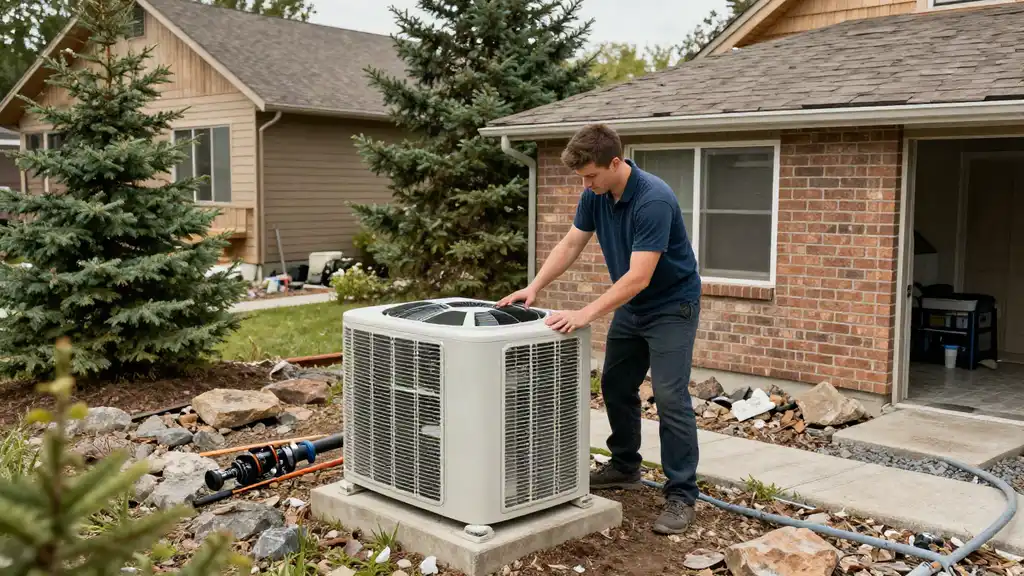
Most homes in Sudbury need a central AC between 2 and 3.5 tons, and the only way to know your number is a room-by-room load calculation - not a square-footage guess. A 1,800 sq ft two-storey house in the South End and a 1,800 sq ft bungalow in Minnow Lake can land a full ton apart, because size depends on insulation, window area, ceiling height, ductwork, and orientation, not floor area alone. Below we walk through how tonnage works, how a Manual J load calculation is done, and what happens when a system is sized wrong.
The short answer on central AC size for Sudbury homes
Central AC sizing in Sudbury is the process of matching a system's cooling capacity to the actual heat your home gains on the hottest afternoon of the year. Get it right and the unit runs long, steady cycles, pulls humidity out of the air, and lasts 15 to 20 years. Get it wrong and you pay for it every summer - in higher bills, uneven rooms, and premature repairs.
As a rough starting point, most Sudbury homes fall into these bands:
- 900-1,200 sq ft bungalow: 1.5 to 2 tons
- 1,200-1,800 sq ft two-storey: 2 to 2.5 tons
- 1,800-2,400 sq ft two-storey: 2.5 to 3 tons
- 2,400-3,200 sq ft with a walkout basement: 3 to 3.5 tons
Those are starting points, not answers. We have installed 2-ton systems in 2,200 sq ft homes with excellent insulation and new triple-glazed windows, and 3-ton systems in 1,700 sq ft homes with a west-facing wall of 1980s double-pane glass. The house decides.
What does "tonnage" actually mean?
One ton of cooling equals 12,000 BTU per hour of heat removal. That term comes from the old days of melting ice - one ton of ice absorbed 12,000 BTU over 24 hours - but today it is just shorthand for capacity. A 2-ton central air conditioner moves 24,000 BTU/h out of your house; a 3-ton moves 36,000 BTU/h.
You will see the number on the data plate of the outdoor condenser as a model code. A model starting with 24 is 2 tons, 30 is 2.5 tons, 36 is 3 tons, and 48 is 4 tons. If your installer cannot tell you the tonnage of the unit they are quoting, that is a red flag.
Central AC tonnage in Sudbury is not something you scale up "just to be safe." A bigger unit does not cool better - it cools faster and shuts off sooner, which is the exact opposite of what you want.
Why square footage alone gets it wrong in Sudbury
Square footage is one input out of a dozen. Two houses with identical floor plans can need different tonnage because of how they were built and how they sit on the lot.
Here is what actually moves the number in Sudbury:
- Window area and glazing. A wall of south- or west-facing windows can add half a ton of load on its own. Triple-glazed low-E glass cuts that dramatically.
- Insulation and air sealing. A 1970s home in Central AC Installation for Older Homes in Sudbury, Ontario often has R-12 attic insulation and leaky sill plates. A 2015 build has R-50 and a tight envelope.
- Ceiling height and layout. Vaulted ceilings and open stairwells add volume that has to be cooled.
- Ductwork condition. Leaky ducts in a hot attic or unheated crawlspace can lose 20 to 30 percent of your cooling before it reaches the room.
- Orientation and shade. A house with mature maples on the west side runs cooler than the same house on a bare lot.
- Occupancy and appliances. A finished basement with a home theatre or a kitchen with a commercial-style range adds internal heat gain.
That is why a proper Central AC System Design & Sizing in Sudbury, Ontario always starts with measurements, not a phone call asking for your square footage.
How is central AC size calculated in Sudbury?
A Manual J load calculation is the industry-standard method for determining how much heat a home gains and loses, and it is the only sizing method recognized by building codes and equipment manufacturers. It takes 45 minutes to two hours depending on the house.
Here is what we measure and record during a load calc:
- Room-by-room dimensions - length, width, ceiling height, and volume.
- Window and door inventory - size, orientation, glazing type, frame material, and whether they have exterior shading.
- Insulation values - attic, walls, and any exposed floor over a crawlspace or garage.
- Air leakage - we look at sill plates, rim joists, chimney chases, and recessed light penetrations.
- Duct system assessment - supply and return sizes, insulation, and whether the layout can handle the airflow the new unit needs.
- Local design conditions - Sudbury's summer design temperature sits around 28°C with a design humidity that matters more than most homeowners realize.
Those inputs go into Manual J software, which produces a total BTU/h load and a room-by-room breakdown. From there, we select equipment that matches the load, then verify the ducts can move the required airflow - typically 350 to 450 CFM per ton.
If the ducts are undersized, no amount of correct tonnage will save you. That is when we look at Ductwork Design in Sudbury, Ontario before we touch the equipment selection.
What size central AC do I need for my Sudbury Ontario home?
For most Sudbury homes, the answer lands between 2 and 3 tons, but the only way to know yours is a Manual J load calculation on your specific house. The table below shows typical results we see, but treat it as a reality check, not a shortcut.
- 1,000 sq ft bungalow, 1980s, average insulation: 1.5-2 tons
- 1,400 sq ft two-storey, 1990s, good insulation: 2 tons
- 1,800 sq ft two-storey, 2000s, tight envelope: 2-2.5 tons
- 2,200 sq ft two-storey with walkout basement: 2.5-3 tons
- 2,800 sq ft with vaulted ceilings and large west glass: 3-3.5 tons
Two-storey homes have their own quirks. Heat stacks on the second floor, and the thermostat on the main level never sees it. If your upstairs bedrooms run 4°C warmer than the main floor every July, you may need a Central AC Installation for Multi-Storey Homes in Sudbury, Ontario with a zoning strategy rather than a bigger single-zone unit.
Older homes in neighbourhoods like Central AC Installation in Kingsmount and the West End often have undersized ducts from the era when they were heated by a coal furnace and cooled by open windows. Those homes need a duct review before sizing, not after.
Oversized vs undersized central AC in Sudbury Ontario
Oversized vs undersized central AC in Sudbury Ontario is not a coin flip - both are bad, but they fail in different ways. Oversizing is the more common mistake because contractors who skip the load calc default to "one size up" as insurance.
What happens when the unit is too big
- Short cycling. The unit blasts cold air for 5 to 8 minutes, hits the thermostat setpoint, and shuts off. Then it repeats. That start-stop cycle is the hardest thing on a compressor.
- Poor humidity control. A properly sized unit runs 15 to 20 minutes per cycle, which is how long it takes to pull moisture out of the air. A short-cycling unit never gets there. You end up with a house that feels cold and clammy at the same time.
- Higher energy bills. Every compressor start draws a surge of current. Ten short cycles cost more than three long ones.
- Shorter equipment life. An oversized system can lose 3 to 5 years off its expected lifespan.
- Noisier operation. A 3-ton unit moving through ducts designed for 2 tons is loud.
What happens when the unit is too small
- It never catches up. On a 30°C afternoon, the indoor temperature climbs and the unit runs continuously without reaching setpoint.
- Wear and tear. Continuous operation at 100 percent capacity shortens compressor life.
- Comfort complaints. The rooms farthest from the air handler never get cool.
If you are replacing an existing system, we can often tell you what the old unit was doing wrong just by reading the model number and looking at the duct layout. That is part of what we do on every Central AC Replacement in Sudbury, Ontario - the old unit's failure pattern usually tells the story.
Common sizing mistakes we see in Sudbury
The same handful of errors show up on almost every mis-sized system we are called to fix. If you are getting quotes, watch for these.
- Sizing off square footage only. A contractor who quotes tonnage over the phone without seeing the house is guessing. It takes a site visit to do this properly.
- Matching the old unit's tonnage. The old unit may have been wrong from day one, or the house may have been re-insulated since. Never size to the equipment you are removing.
- Ignoring the ducts. A new 3-ton condenser on ducts built for 2 tons will underperform and run loud. Duct capacity is part of sizing.
- Forgetting the basement. A finished basement adds conditioned volume. A walkout basement with west-facing windows adds real load.
- Using a rule of thumb from a different climate. Advice written for Texas or Arizona does not apply to Sudbury's shorter, milder cooling season.
- Skipping the load calc to save time. A proper Manual J takes an hour. Skipping it is how you end up replacing a 4-year-old system.
If you are also upgrading efficiency while you are at it, note that higher-SEER2 equipment does not change the tonnage you need - it changes how much power the unit draws to deliver that tonnage. Sizing and efficiency are separate decisions.
When to call a professional
Call a professional any time you are choosing a tonnage for a new or replacement system, because the calculation requires measurements, software, and duct assessment that you cannot do from a spec sheet. We see homeowners every spring who bought a unit online based on square footage and are now paying us to fix the airflow problems that followed.
At Sudbury Central AC Installation, we run a full Manual J load calculation on every install, review your existing ducts, and walk you through the tonnage and equipment options in plain language before you commit. If your current system short-cycles, leaves rooms uneven, or never quite keeps up in July, that is usually a sizing problem, and it is worth a proper look before you spend money on repairs.
Frequently Asked Questions
What size central AC do I need for my Sudbury Ontario home?
Most Sudbury homes need 2 to 3 tons. A 1,000 sq ft bungalow typically lands at 1.5-2 tons, a 1,800 sq ft two-storey at 2-2.5 tons, and a 2,400 sq ft home with a walkout basement at 2.5-3 tons. Your exact number requires a Manual J load calculation.
How is central AC size calculated in Sudbury?
Through a Manual J load calculation, which measures room-by-room dimensions, window area and orientation, insulation values, air leakage, and duct capacity, then applies Sudbury's summer design conditions. The result is a BTU/h load that determines tonnage. It takes 45 minutes to two hours on site.
What happens if my central AC is too big in Sudbury Ontario?
An oversized unit short-cycles - running 5 to 8 minutes at a time instead of 15 to 20. That means poor humidity removal, higher energy bills, more compressor wear, and a lifespan cut by 3 to 5 years. Bigger is not better; matched is better.
Who can size a central AC near me in Sudbury Ontario?
A licensed HVAC contractor with Manual J software and on-site measurement capability. If a quote comes without a site visit or a load calculation, it is a guess. We run a full load calc on every install and review your ducts at the same time.
Does square footage determine central AC size in Sudbury?
No. Square footage is one input among many. Window area, insulation, ceiling height, duct condition, orientation, and occupancy all shift the number - often by a full ton on homes of identical size. Use square footage as a sanity check, never as the answer.
Get help with Central AC Installation in Sudbury
If you want a straight answer on the right tonnage for your house, we will measure it, run the load calculation, and quote you a system that actually fits. No guesswork, no upsizing, no surprises.
Call Sudbury Central AC Installation at 444-333-111 to book your sizing assessment.